
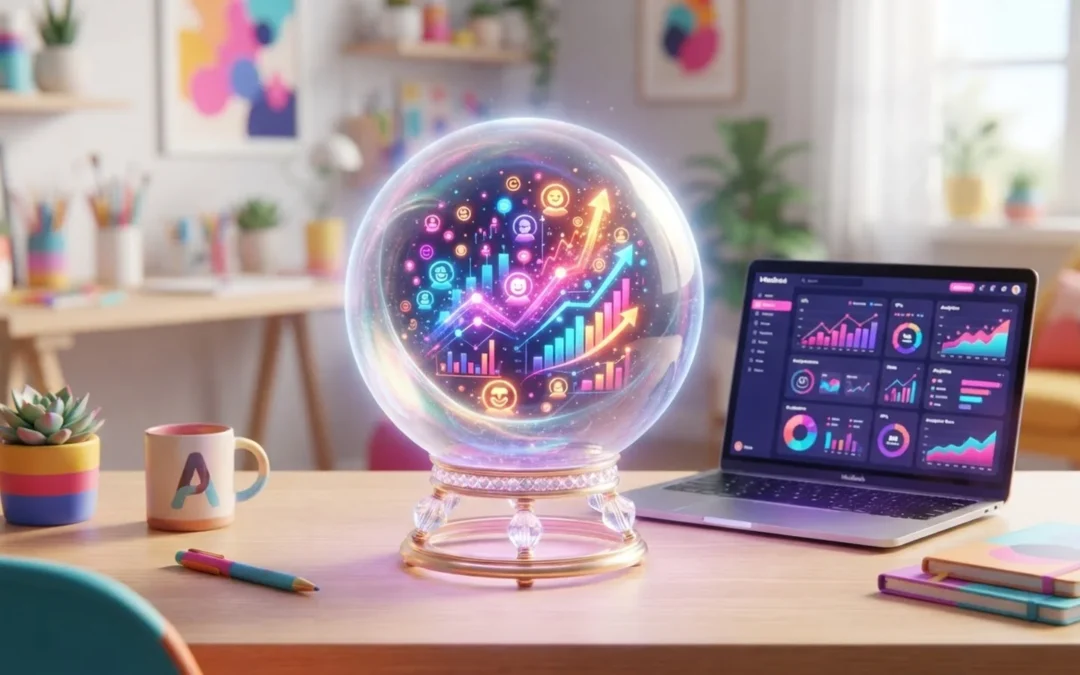
Marketing used to rely heavily on looking back: what sold last season, which campaign performed best, who bought what. Predictive analytics flips that around. It uses past and present data to estimate what is likely to happen next, so you can act before a trend peaks or a customer drifts away.
When artificial intelligence is added to the mix, those predictions can be made faster and across far more data than a person could review alone. It’s a powerful tool. It also needs a thoughtful human steering it.
What predictive analytics is
Predictive analytics combines historical data with statistical methods and machine learning to answer one question: what is likely to happen next? AI-powered versions can sort through very large data sets and spot patterns and relationships people would miss.
How it works, step by step
- Collect and clean the data. Sales records, website behavior, email engagement and customer information are gathered, and errors or duplicates are removed.
- Build and train a model. The model learns from historical data, looking for patterns that tend to come before a specific outcome, such as a purchase or a cancellation.
- Test it. The model is checked against data it hasn’t seen before to confirm its predictions hold up.
- Put it to work. Once it’s reliable, the model runs on live data and produces forecasts the team can act on.
- Keep it learning. Markets change, so the model is retrained with new data over time.
Where it helps marketing teams
Smarter segmentation
Instead of grouping customers only by age or location, predictive models can group them by behavior: how often they buy, what they browse and how they respond to different messages. That helps you choose the right channel and the right offer for each group.
Finding your most promising prospects
Lead scoring uses past behavior to estimate which prospects are most likely to buy. Your team can then spend its time on the conversations most likely to matter, instead of treating every lead the same.
Spotting customers who are about to leave
Customers rarely leave without warning. Their engagement drops, purchases slow down or support requests increase. A predictive model can flag those signals early, giving you a chance to reach out, ask what’s wrong and fix it while the relationship can still be saved.
Seeing trends sooner
For industries like fashion and beauty, timing is everything. Models that monitor sales data, search interest and social conversation can surface emerging trends early, which helps with product planning and campaign timing.
More relevant personalization
“Dear customer” emails don’t work anymore. Predictive insights make it possible to recommend products based on what someone actually bought or browsed. The goal is to be helpful, not to show off how much data you have.
What big brands are doing
Large companies have invested heavily in this area. L’Oréal, for example, has publicly discussed using AI-powered trend detection that scans online conversations to spot emerging beauty trends early and inform product development. You don’t need a global budget to benefit from the same ideas, though. Many email platforms, CRMs and ecommerce tools now include predictive features that small businesses can use right away.
Why the human touch still matters
Predictions are only as good as the data behind them, and data can be incomplete or biased. A model might tell you which customers are likely to buy, but it can’t tell you whether a particular message respects their privacy or fits your brand values. That judgment belongs to people.
My own doctoral research focuses on how AI-driven marketing affects consumer trust and autonomy, and the takeaway so far is consistent: the brands that win long term use AI to inform decisions, not to replace them. Be transparent about how you use customer data, give people real choices and keep a human in the loop.
If you’d like help figuring out where AI fits in your marketing, and where it doesn’t, let’s talk.

Recent Comments